 Volume One
Layflat or casewrap? Choosing the binding for a baby photo book
The binding decides whether a photograph can run across two pages and whether the book survives a decade of bedtimes. What layflat and casewrap actually mean, what each costs, and which to choose for a baby photo book.
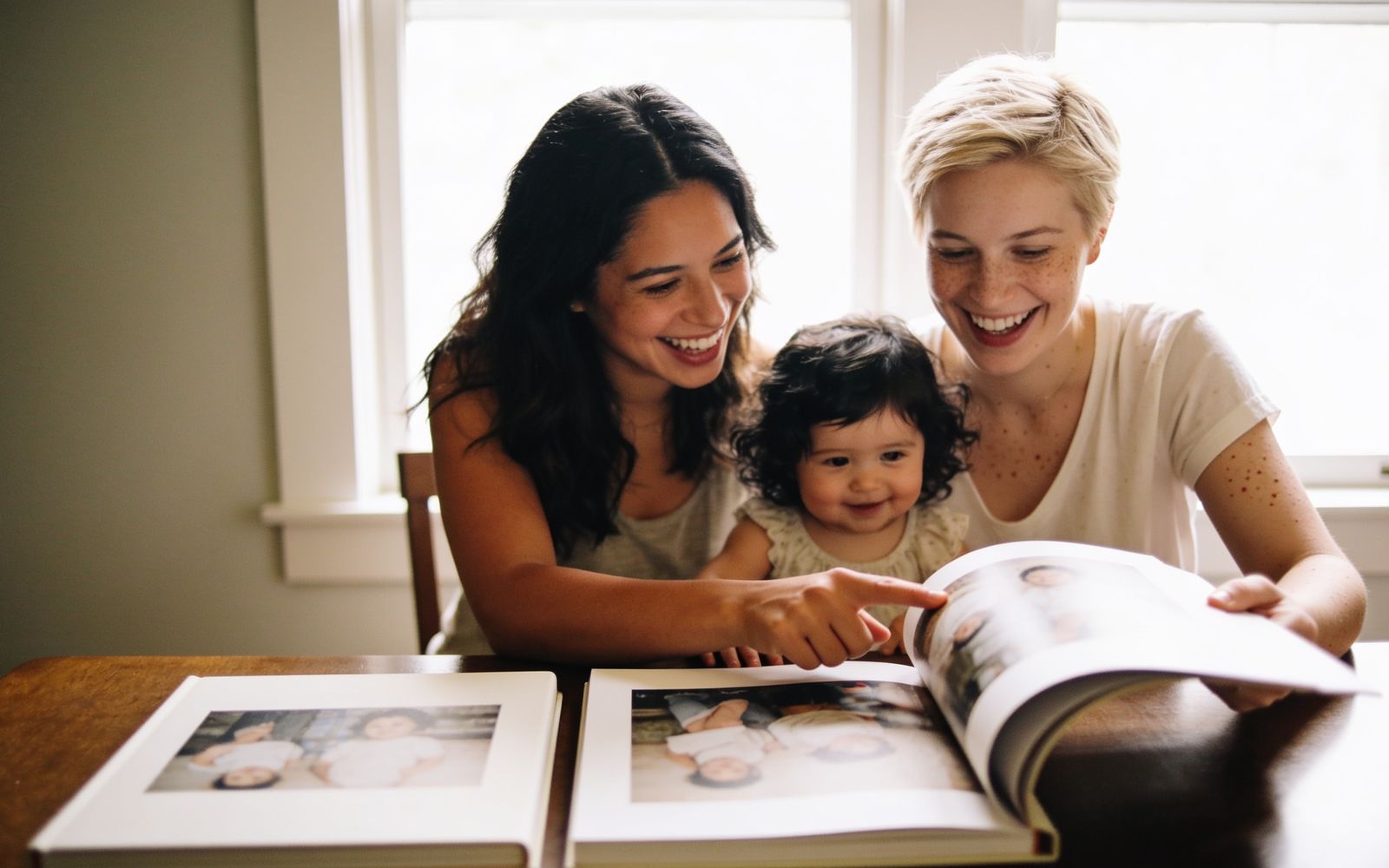
Every baby photo book service offers a choice of binding, usually with a small price difference and no explanation. The choice matters more than the paper, more than the cover material, and more than most of the layouts. Here is what the two common bindings actually are, and how to choose.
Casewrap: the standard hardcover
A casewrap (sometimes "perfect bound hardcover" or "case bound") is a stack of pages glued along the spine and wrapped in a hard cover. It is how most books on your shelf are made. It is sturdy, it is inexpensive, and it is what most print-on-demand services build by default.
The cost is the fold. Because the pages are glued, the book does not open flat: the inner edge of every page curves down into the spine. Roughly 10 to 15 mm on each side of the fold is hard to see, and anything printed there, a face, a caption, a milestone date, is partly lost. Printers ask designers to keep text out of a "gutter" for exactly this reason. A photograph that runs across two pages loses its middle strip.
Casewrap books also open at a shallow angle, so reading one in a lap means holding it open with a hand. A baby book gets read in laps.
Layflat: the album binding
A layflat book is made from thicker pages, mounted so that each spread is one continuous sheet folded at the spine. Opened, it lies completely flat, and the two pages meet at the fold with nothing lost between them. A photograph can run across the whole spread, edge to edge, without a face falling into the gutter.
The pages are stiffer, often board-mounted, which is why layflat books feel like albums rather than novels. They cost more, they are heavier, and they have a lower maximum page count (most layflat lines stop somewhere between 100 and 130 pages, where a casewrap can run to several hundred).
What this means for a baby book
Three things decide it.
Panoramas. If you want a photograph across two pages (the shake-off on the porch, the first steps across the kitchen), you need a layflat. A casewrap will eat the middle. A good engine will refuse to send a panorama to a casewrap at all and print it as a full page instead; that is what Volume One does for its Everyday Edition.
Full-page photographs. Both bindings print a photograph to the edge of a page (the "bleed"). On a casewrap, the inner edge still curves; on a layflat the whole picture is visible. If your photographs are the point of the book, layflat shows more of them.
Handling. A baby book is opened on a bed, on a floor, on a grandmother's lap, by a toddler. A layflat book opens under its own weight and its thick pages tolerate small hands. A casewrap is fine on a shelf and less fine in a cot.
What each costs
Prices vary by printer, but the pattern holds: a 40-page square casewrap from a print-on-demand service runs roughly $20 to $35 to produce; the same book layflat runs $45 to $80. Retail baby photo book services price accordingly. Volume One includes a layflat volume in its single price, and offers a casewrap Everyday Edition as an inexpensive second copy for grandparents.
How to judge a binding before you buy
Ask three questions of any service:
- Does the book open flat? If the product photographs only show the book closed or opened at an angle, assume it does not.
- Can a photograph run across two pages? If the answer is "yes, but keep faces out of the middle," the answer is no.
- What is the page count included, and what does a page beyond it cost? Layflat pages are expensive; a service that includes 20 pages and charges per page after is not the price on the box.
The short version
Choose layflat for a book of photographs, especially one you will read with a child. Choose casewrap for a cheaper second copy or a book that is mostly words. If you can only have one, make it the one that lies flat: it is the book that gets opened.